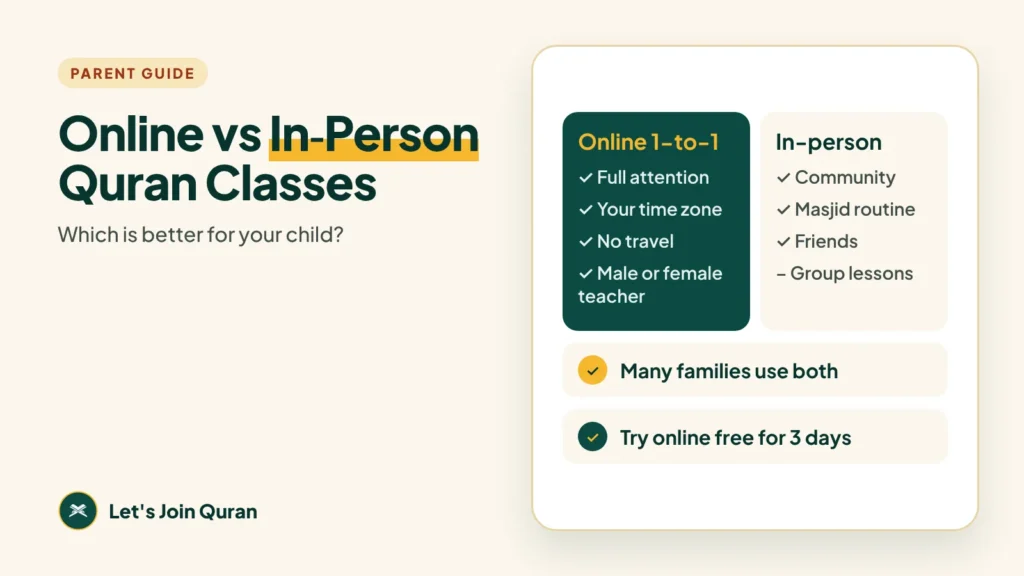
Online vs in-person Quran classes: neither is automatically better for a child. Both can work very well. What decides the result is the teacher, how much individual attention your child gets, how regular the lessons are, and whether the format fits your family’s week. For many families abroad, live one-to-one online classes now give more attention than a busy evening madrasa, while a good local class still offers community and routine.
This guide compares the two side by side so you can choose with confidence.
Online vs in-person Quran classes at a glance
| What matters | One-to-one online class | In-person madrasa or class |
|---|---|---|
| Attention | The teacher hears every letter your child reads | Often one teacher with a group |
| Choice of teacher | Not limited to your area; male or female teacher | Limited to who is nearby |
| Timings | Set to your time zone and family routine | Fixed times, plus travel |
| Pace | Moves at your child’s speed | Usually follows the group |
| Community | Less social contact with other children | Friends, masjid life and shared routine |
| Parent’s view | You can hear the lesson from the next room | Depends on the madrasa |
Access to qualified teachers
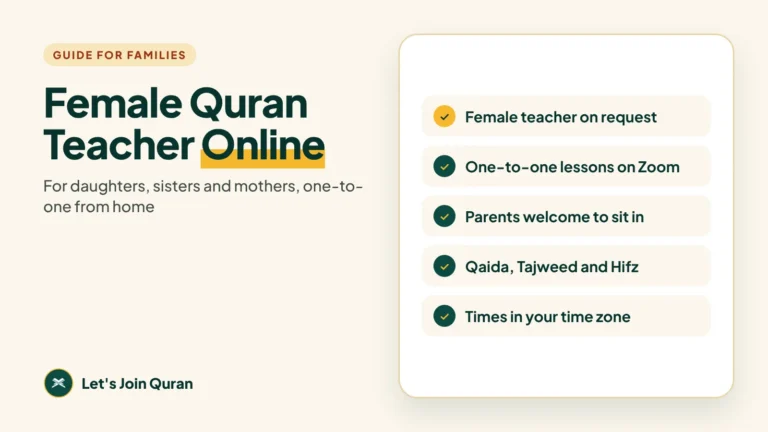
In-person options depend on where you live. A family in a small town in the United Kingdom or a suburb in the United States may have one madrasa nearby, or none. Online, a child can learn from an experienced teacher wherever they are, and families can ask for a female teacher for daughters.
Individual attention and pace
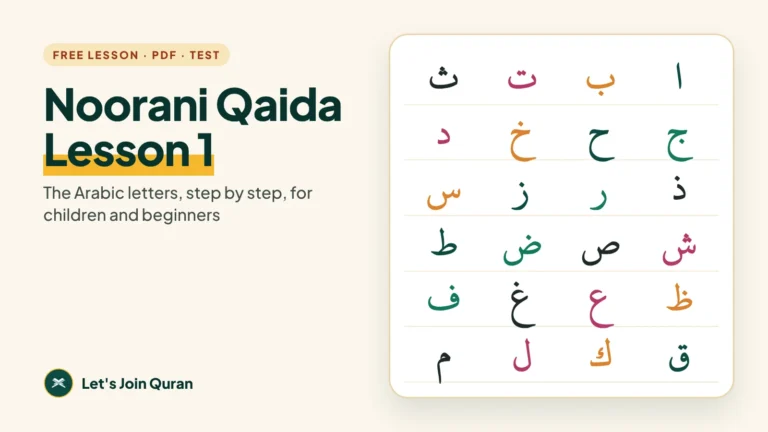
Correct recitation is built letter by letter. In a group, a teacher may hear each child for only a few minutes. In a one-to-one online class, the whole lesson is your child’s, so mistakes in sounds like ع, ح and ق are caught straight away. Children who are shy in a group often speak up more freely one-to-one.
Pronunciation and Tajweed
Good pronunciation needs close listening. Online, the teacher hears the child clearly through headphones and corrects every slip. In person, the teacher can also watch the mouth more closely, which helps with some letters. Either way, what matters is a teacher who listens carefully and corrects calmly. You can read more in our guide What Is Tajweed?
Convenience, routine and travel
Online classes remove the drive, which saves time on school nights and in winter. They also fit around after-school activities. The risk is that home can be distracting, so a fixed time and a quiet corner are important. In-person classes give a clear routine and a change of place, which some children need.
Community and Islamic environment
This is where a good local madrasa shines. Children make friends, pray in the masjid and feel part of a community. Many families get the best of both: one-to-one online lessons for reading and Tajweed, and the local masjid for prayer, events and friendships.
Cost
Local classes are sometimes cheaper per hour because many children share one teacher. One-to-one online lessons cost more per hour but give full attention, which can mean faster progress. Compare what your child actually gets in each lesson, not only the price. You can see our plans on the pricing page.
Safeguarding and parental involvement
For online classes, ask how teachers are checked, whether parents can sit in, and whether all contact goes through the parent. For in-person classes, ask about supervision, pick-up and who is in the room. A good provider, online or local, welcomes these questions.
What a week of online classes looks like
A typical beginner has three 30-minute lessons a week, for example Monday, Wednesday and Friday after school. Each lesson starts with a quick revision of the last page, then a new part of the Qaida, then a few minutes of reading practice. Between lessons, the child spends ten minutes a day on the same page at home, and a parent hears it once. That small daily habit is what makes online learning work.
How to make online classes work at home
- Use a laptop or tablet so the page is large enough to read.
- Set up the same quiet spot for every lesson.
- Join a few minutes early so the class starts on time.
- Stay within earshot, especially with younger children.
- Ask the teacher for one thing to practise before the next class.
So which is better for your child?
Choose online if your child needs individual attention, you have no good teacher nearby, or your evenings are tight. Choose in-person if your child thrives in a group and you have a trusted madrasa close by. If you are unsure, try both. A free trial costs nothing and shows you how your child responds.
Try an online class and see for yourself
Let’s Join Quran offers live one-to-one classes in Noorani Qaida, Quran Reading, Tajweed and Hifz, with male and female teachers subject to availability. Before booking, you can try our free online Noorani Qaida with your child at home. When you are ready, book a 3 days free trial.
Are online Quran classes good for kids?
Yes, when they are live, one-to-one and with a patient teacher. The teacher hears every letter, corrects mistakes straight away and moves at the child’s pace.
Is a madrasa better than online Quran classes?
Not automatically. A good madrasa gives community and routine; one-to-one online classes give more individual attention. Many families combine both.
What age can a child start online Quran classes?
Many children start around 4 to 6 years old with short lessons, once they can sit and focus for 20 to 30 minutes with a parent nearby.
How can I keep my child focused in online classes?
Use a fixed time, a quiet corner, a laptop or tablet rather than a small phone, and stay nearby for the first lessons.
What equipment do we need?
A laptop, tablet or phone with a camera, a steady internet connection and Zoom.

Let’s Join Quran is an online Quran academy dedicated to helping children, adults, and families learn the Quran with confidence through live 1-to-1 online classes. Our teachers focus on Noorani Qaida, Quran Reading, Tajweed, Hifz support, Islamic Studies, and beginner-friendly Quran learning for students worldwide.