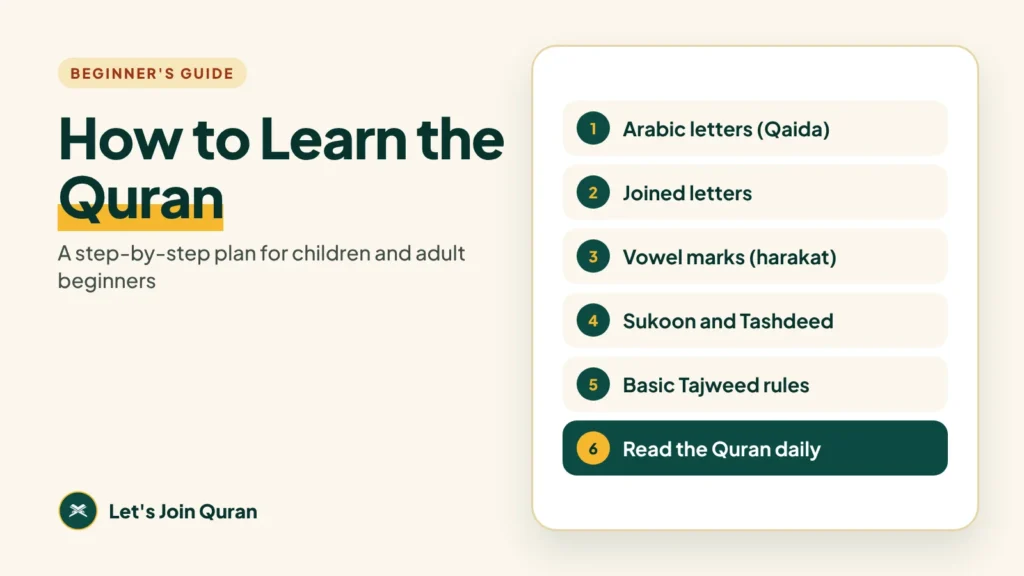
To learn the Quran, start with the Arabic letters, then learn the vowel marks, then join letters into words, then learn the basic Tajweed rules, and only then read the Quran itself, a little every day, with a teacher who listens and corrects you. This is the path almost every child and adult beginner follows, whether they learn in a mosque or online.
This guide walks through each step in order, how long each one usually takes, the free tools you can use at home, and the mistakes that slow most learners down.
Step 1: Decide what “learning the Quran” means for you
People mean different things by learning the Quran. Being clear from the start helps you choose the right course and keeps you motivated.
- Reading: reading the Arabic text correctly from the mushaf. This is the first goal for most beginners.
- Tajweed: reading with the correct sounds, lengths and rules, as the Quran was revealed.
- Memorising (Hifz): learning surahs or the whole Quran by heart.
- Understanding: learning the meaning through a translation and tafsir.
For a child or a complete beginner, reading with basic Tajweed comes first. Memorising and understanding grow alongside it.
Step 2: Learn the Arabic letters with the Noorani Qaida
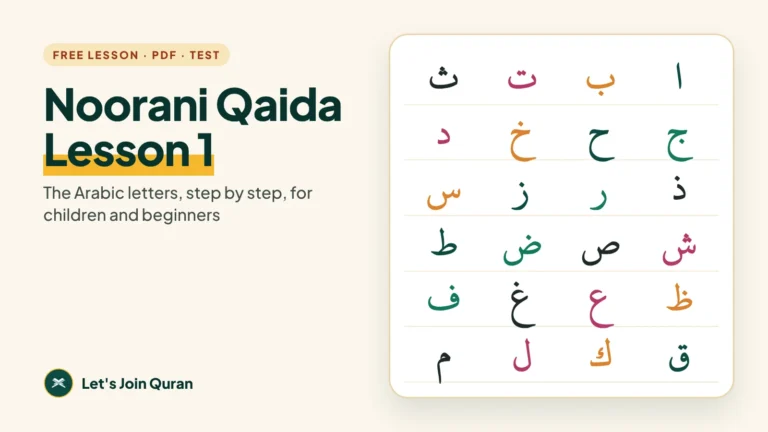
The Noorani Qaida is the beginner’s book used in Pakistan, India, the United Kingdom and around the world. Its first lesson teaches the single Arabic letters: their names, shapes, dots and correct sounds. Do not rush this step. Every later step depends on knowing each letter in any order, not just reciting them from Alif to Ya.
Start here: Noorani Qaida Lesson 1 explains every letter and how to teach it, and our free online Noorani Qaida has every page, a PDF and a test for each chapter.
Step 3: Learn joined letters
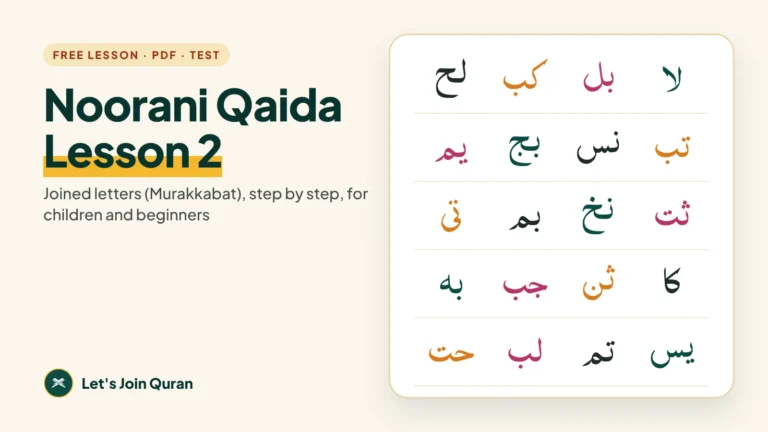
In the Quran, letters join together and change shape. The next lesson of the Qaida teaches how to recognise each letter inside a joined pair. Our guide to Noorani Qaida Lesson 2 covers the joined shapes, the six letters that never join to the next one, and the look-alike letters that differ only by their dots.
Step 4: Learn the vowel marks (harakat)
Arabic letters take short vowel marks: Fatha (a), Kasra (i) and Damma (u). Then come Tanween (the doubled marks that add an “n” sound), the standing marks, and the long vowels (Madd). With these, a learner can read real syllables for the first time. Read slowly and clearly here; speed comes later.
Step 5: Learn Sukoon, Tashdeed and how words flow
Sukoon (Jazm) stops a letter, and Tashdeed doubles it. Together they let a learner read whole Quranic words smoothly. The last pages of the Noorani Qaida practise these with real words from the Quran, which is the bridge from the Qaida to the mushaf.
Step 6: Learn the basic Tajweed rules
Tajweed makes your recitation correct, not just readable. Beginners usually learn these first:
- Where each letter comes from (makharij), and the seven heavy letters.
- The rules of Noon Saakin and Tanween, and Meem Saakin.
- Ghunnah (the nasal sound) and Qalqalah (the echo).
- Madd: how long to stretch a vowel.
Our article What Is Tajweed? explains the basics simply, and the free Tajweed Rules course covers every rule with examples and tests.
Step 7: Start reading the Quran
Once the Qaida is finished, many teachers start with the short surahs of the 30th Juz (Juz Amma), which are also the ones used in salah. Then the learner reads from the beginning of the Quran, a little at a time, with the teacher listening to every line. A mushaf printed in the same Indo-Pak style as the Qaida makes this step much easier for learners from Pakistan and India.
Step 8: Read every day, even for a few minutes
Short daily practice beats long weekly sessions. Fifteen to twenty minutes a day for a child, or twenty to thirty minutes for an adult, keeps the letters and rules fresh. Pick a fixed time, such as after Fajr or after school, so it becomes a habit.
Step 9: Learn with a teacher who listens
The Quran has always been learned from a teacher, by listening and reading back. A book or an app can show you the letters, but it cannot hear you. Mistakes in sounds like ع, ح, ق or ض are easy to make and hard to notice yourself. A teacher catches them in the first week, before they become habits that take months to undo.
Step 10: Add meaning and memorisation
As reading improves, add a little understanding: read the translation of the surahs you already know, and memorise a new short surah every week or two. This connects reading with salah and daily life, which is what keeps most learners going for years.
How long does it take to learn the Quran?
It depends on age, daily practice and the teacher. As a rough guide, with regular daily practice:
| Stage | Children (5 to 12) | Adults |
|---|---|---|
| Noorani Qaida (letters to Tashdeed) | About 3 to 6 months | About 1 to 3 months |
| Basic Tajweed rules | Learned gradually while reading | About 2 to 4 months |
| Reading the whole Quran once with a teacher | About 1 to 2 years | About 6 to 12 months |
These are typical ranges, not targets. Some learners are faster and some are slower, and that is fine. Correct reading matters far more than speed.
Tips for children
- Keep lessons short and the same time every day.
- Praise effort, not only results.
- Use games for revision. Our free Quran Games for Kids practise letters, marks and duas.
- Let them hear good recitation at home.
Tips for adults
- Do not feel embarrassed to start from the letters. Most adults who learn properly do the same.
- Choose a teacher of the same gender if you prefer; many academies offer both.
- Fit practice around work: ten minutes in the morning and ten at night works well.
- Learn the meaning of what you read in salah first. It changes how the prayer feels.
Mistakes that slow learners down
- Rushing the Qaida. Weak letters return in every later lesson.
- Learning only from transliteration. English letters cannot show Arabic sounds correctly.
- Skipping Tajweed. Bad habits are hard to fix once they are fixed in memory.
- Practising without correction. Reading alone for months can repeat the same mistake thousands of times.
- Long gaps. A week off often costs more than a week of practice gained.
Learn the Quran online, one-to-one
If there is no good class near you, or the timings do not suit your family, online one-to-one lessons follow exactly the same steps. A teacher reads with you on a live video call, at a time that fits school or work. At Let’s Join Quran, children and adults start from their own level, with Noorani Qaida, Quran reading and Tajweed classes, with male and female teachers. You can book a 3 days free trial to see how it works, with no card needed.
What is the first step to learn the Quran?
Start with the Arabic letters using the Noorani Qaida. Learn each letter’s name, shape, dots and sound before moving on to joined letters and vowel marks.
Can I learn to read the Quran on my own?
You can learn the letters and practise at home with free tools, but you need a teacher to hear and correct your pronunciation. Mistakes in sounds and Tajweed are very hard to notice by yourself.
How long does it take an adult to learn to read the Quran?
With daily practice, many adults finish the Noorani Qaida in about 1 to 3 months and can read the Quran with a teacher within about a year. It depends on practice and the teacher.
What age should a child start learning the Quran?
Many children start the Noorani Qaida between ages 4 and 6, once they can sit for a short lesson. Short daily sessions work best at this age.
Should I learn Tajweed before reading the Quran?
Learn the basics while you read. The Noorani Qaida already teaches correct letter sounds and marks; the main Tajweed rules are then learned alongside reading the Quran.
Is it better to learn the Quran online or in person?
Both work well when the teacher is good. One-to-one online lessons give full attention and flexible times, while a local class offers community. Choose the one your family can keep up every week.

Let’s Join Quran is an online Quran academy dedicated to helping children, adults, and families learn the Quran with confidence through live 1-to-1 online classes. Our teachers focus on Noorani Qaida, Quran Reading, Tajweed, Hifz support, Islamic Studies, and beginner-friendly Quran learning for students worldwide.