Tajweed is the set of rules for reciting the Quran correctly: saying every letter from its proper place, giving it its proper qualities, and applying the rules of merging, nasal sound, lengthening and stopping. The word comes from the Arabic root j-w-d, which means to make something good or excellent. In short, Tajweed means reciting the Quran the way it was revealed and taught.
This guide explains what Tajweed means, why it matters, which rules beginners learn first, and how long it takes.
What Tajweed means in the Quran
Allah says in the Quran: “and recite the Quran in a measured way” (Al-Muzzammil 73:4). Scholars explain Tajweed as giving each letter its right, both where it comes from (makhraj) and how it sounds (sifaat), and then applying the rules that change a letter’s sound in certain positions.
Tajweed covers three areas:
- Letters: the correct place and quality of each of the 29 letters.
- Rules between letters: what happens when certain letters meet, such as Noon Saakin, Meem Saakin, Idgham and Ghunnah.
- Length and stopping: how long to stretch vowels (Madd) and where to pause (Waqf).
Why Tajweed matters
Some Arabic letters sound close but change the meaning completely. Saying a light س instead of a heavy ص, or a plain ه instead of a deep ح, can turn one word into another. Scholars divide mistakes into two kinds:
- Clear mistakes (lahn jali): changing a letter or a vowel, which can change the meaning. Avoiding these is required of every Muslim who recites.
- Hidden mistakes (lahn khafi): missing finer rules, such as the exact length of a Madd or a light Ghunnah. Avoiding these is part of beautiful, complete recitation.
Tajweed also makes recitation calm and beautiful, which helps the heart and makes memorisation easier.
What beginners learn first
Tajweed is learnt in layers. Our free Tajweed Rules page follows this order, with a short test for every chapter:
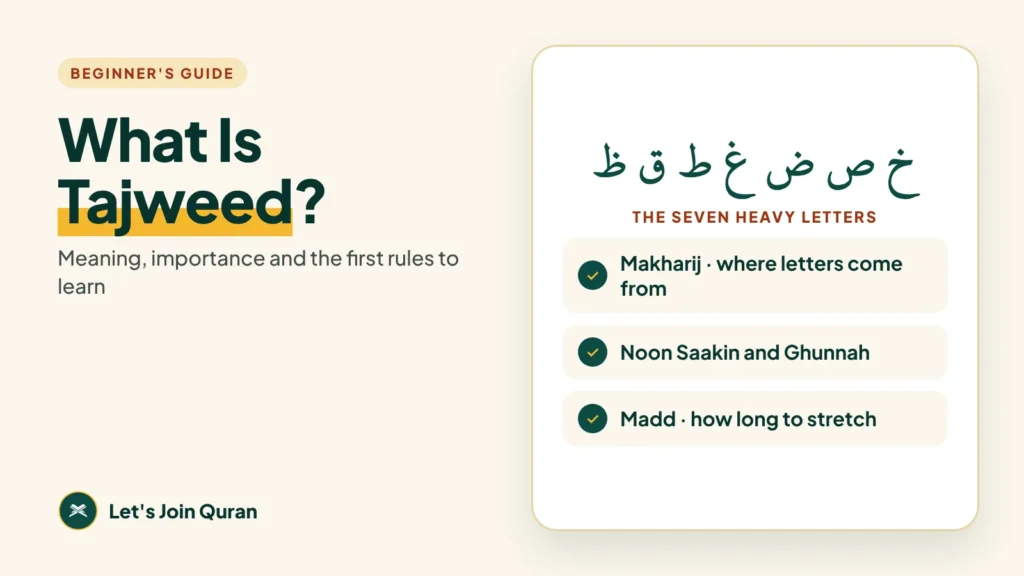
- Makharij: where each letter comes from (throat, tongue, lips, nose).
- Heavy and light letters: the seven heavy letters خ ص ض غ ط ق ظ are read with a full mouth.
- Noon Saakin and Tanween: Izhar, Idgham, Iqlab and Ikhfa.
- Meem Saakin: three rules for a Meem with sukoon.
- Ghunnah and Qalqalah: the nasal sound and the bouncing sound.
- Madd: how long to stretch vowels, from two counts upwards.
- The rules of Laam and Raa, and the signs of stopping.
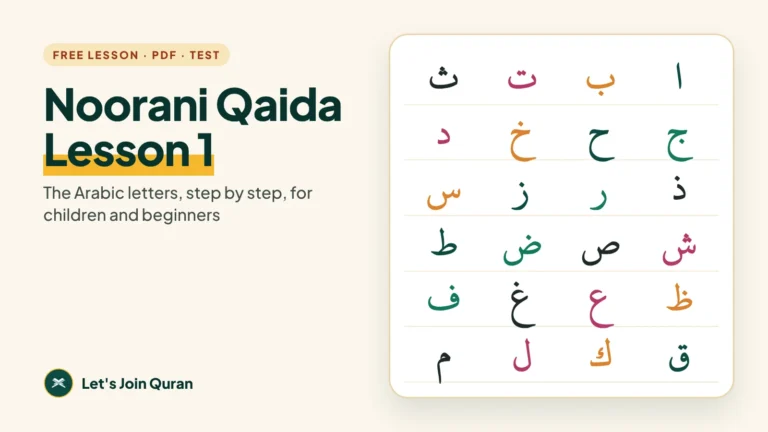
Most of these rules first appear inside Noorani Qaida, which is why a well-taught Qaida is the best start to Tajweed.
Examples of Tajweed rules in the Quran
| Rule | Example | What happens |
|---|---|---|
| Izhar | مَنْ اٰمَنَ | The Noon is said clearly, because a throat letter follows. |
| Idgham | مَنْ يَّقُوْلُ | The Noon merges into the next letter, with Ghunnah. |
| Iqlab | مِنْۢ بَعْدِ | The Noon turns into a Meem sound before ب. |
| Ikhfa | اَنْتُمْ | The Noon is hidden in the nose before ت. |
| Qalqalah | اَحَدْ | The د bounces slightly when you stop on it. |
| Madd | قَالُوْٓا | The vowel is stretched longer because of the Madd sign. |
Each of these is explained with more examples and a short test on our free Tajweed Rules page.
Can you learn Tajweed on your own?
You can learn the rules from a book or a website. You cannot reliably check your own pronunciation. Most people cannot hear their own small mistakes, especially in the throat letters and the heavy letters. That is why Tajweed has always been taught face to face, with a teacher listening and correcting. Learning the rules yourself and reciting to a teacher is the most effective mix.
How long does it take to learn Tajweed?
A student who already reads the Quran can learn the main rules in about three to six months with regular lessons. Applying them smoothly in every verse takes longer, often a year or more of steady recitation with correction. Children who learn Tajweed through the Qaida from the start usually find it more natural later.
Learn Tajweed with a teacher
In our one-to-one Tajweed course, the teacher listens to your recitation on a live video call and corrects each rule as it appears in real verses. Beginners can start with Noorani Qaida or Quran Reading, and adults can join Quran for Adults. Book a 3 days free trial to see where you stand.
What is Tajweed in simple words?
Tajweed is reciting the Quran correctly: saying each letter from its proper place with its proper quality, and following the rules of merging, nasal sound, lengthening and stopping.
What does the word Tajweed mean?
It comes from the Arabic root j-w-d, meaning to make something good or excellent. Tajweed means making your recitation excellent.
Is Tajweed compulsory?
Avoiding clear mistakes that change letters, vowels or meaning is required for every Muslim who recites the Quran. Finer rules complete the recitation and are strongly encouraged.
What are the basic rules of Tajweed?
Beginners usually start with Makharij, heavy and light letters, the rules of Noon Saakin and Tanween, Meem Saakin, Ghunnah, Qalqalah and Madd.
How long does it take to learn Tajweed?
The main rules can be learnt in about three to six months of regular lessons. Applying them smoothly in every verse usually takes a year or more of recitation with a teacher.

Let’s Join Quran is an online Quran academy dedicated to helping children, adults, and families learn the Quran with confidence through live 1-to-1 online classes. Our teachers focus on Noorani Qaida, Quran Reading, Tajweed, Hifz support, Islamic Studies, and beginner-friendly Quran learning for students worldwide.