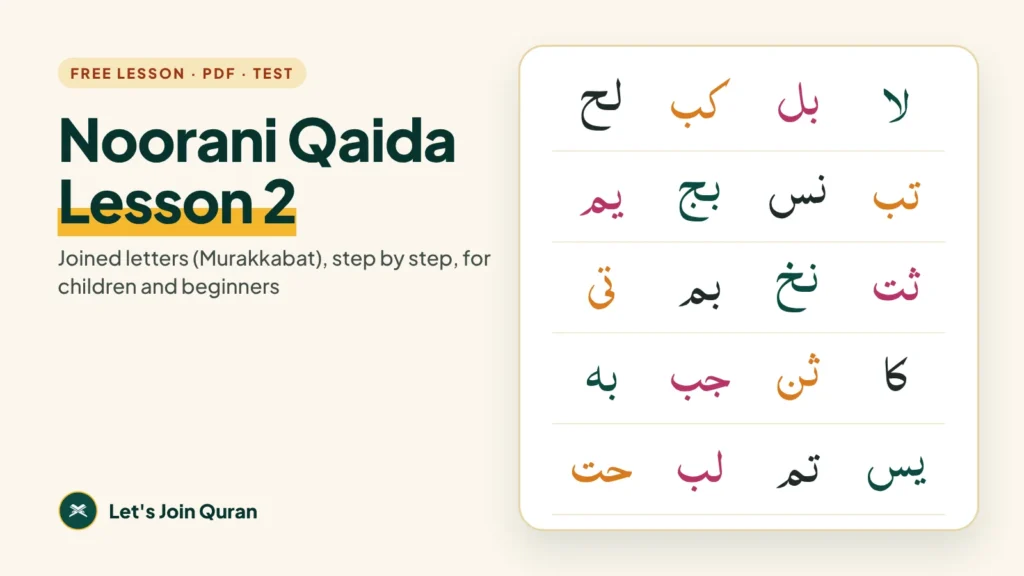
Noorani Qaida Lesson 2 teaches joined letters, called Murakkabat. Your child learns how Arabic letters change shape when they connect, and how to pick out each letter inside a joined pair such as لا, بل or کب. You can open the whole lesson for free in our online Noorani Qaida, print it as a PDF, and check your child with a short test at the end.
This guide explains what Lesson 2 contains, the rules that make joined letters easy, the letters children confuse most, and how to teach the lesson at home.
What Noorani Qaida Lesson 2 covers
In Lesson 1 every letter stood on its own. In real Arabic writing, and in the Quran, letters join together, and most of them change shape when they do. Lesson 2 builds the bridge between the two. It covers pages 3 to 5 of our Qaida and has two goals:
- Recognise each letter inside a joined word. In لا, for example, the letter on the right is Laam and the letter on the left is Alif.
- Tell look-alike letters apart by their dots. Many letters share one body when joined, so the dots are often the only difference.
There are no vowels yet. Your child names the letters in each pair, from right to left, for example “Ba, Laam” for بل.
Why letters change shape when they join
Most Arabic letters have up to four shapes: on its own, at the start of a word, in the middle and at the end. The letter is the same; only its shape changes so that it can link to its neighbours. Usually the start and middle shapes are shortened, and the full “tail” of the letter appears only at the end.
| Letter | Name | Start | Middle | End |
|---|---|---|---|---|
| ب | Ba | بـ | ـبـ | ـب |
| ج | Jeem | جـ | ـجـ | ـج |
| س | Seen | سـ | ـسـ | ـس |
| ع | Ain | عـ | ـعـ | ـع |
| ک | Kaaf | کـ | ـکـ | ـک |
| ل | Laam | لـ | ـلـ | ـل |
| م | Meem | مـ | ـمـ | ـم |
| ه | Ha | ھـ | ـھـ | ـه |
| ي | Ya | يـ | ـيـ | ـي |
Your child does not need to learn this table by heart. It helps you, as the parent or teacher, see why a letter can look “wrong” inside a word. The Qaida shows the joined shapes one pair at a time, so the eye gets used to them slowly.
The six letters that never join to the next letter
Six letters join to the letter before them but never to the letter after them:
ا د ذ ر ز و
Alif, Daal, Zaal, Raa, Zaa and Waw. After one of these, the next letter always starts fresh, as if it began a new word. This one rule explains many “gaps” children see inside Arabic words. Hamza (ء) on its own line does not join to either side.
Letters that look the same when joined
At the start or in the middle of a word, several letters lose their tail and keep only a small “tooth” or body. Then only the dots tell them apart:
- بـ تـ ثـ نـ يـ: Ba, Ta, Saa, Noon and Ya all become a small tooth. One dot below, two above, three above, one above, two below.
- جـ حـ خـ: one dot below, no dot, one dot above.
- سـ شـ: no dots, then three dots above.
- صـ ضـ and طـ ظـ: no dot, then one dot above.
- عـ غـ: no dot, then one dot above.
- فـ قـ: one dot above, then two dots above. When joined, both look almost the same, so the dots matter.
This is exactly why the Qaida asks the teacher to “move the dots around”: if the dot of ب goes above it, which letter is it now? If the dots of ت go below it, which letter is it? A child who can answer quickly will rarely misread a letter later.
Shapes that surprise children
- لا (Laam Alif). Laam and Alif join into one crossed shape. Children often read it as one letter. Teach it as two: “Laam, Alif”.
- ه in the middle. In Qaidas printed in Pakistan and India, Ha at the start or middle is often written as ھ, the “two-eyed” shape. It is the same letter Ha.
- ک and ك. Our Qaida uses both shapes of Kaaf. They are the same letter, written in two styles.
- ة (round Ta). This letter appears at the end of some pairs. For now, your child only needs to recognise it; how to read it comes with the vowels in later lessons.
How to teach Lesson 2 at home
- Read from right to left. Point to the right-hand letter first, then the next one. Say “Laam, Alif”, not “Alif, Laam”.
- Break every pair apart. Ask, “Which letters are in this one?” Your child names each letter separately before moving on.
- Play the dot game. Cover the dots with your finger, then ask what the letter would be with one dot below, two above or three above.
- Find the tail. Show that the full shape of a letter usually appears only at the end of a word.
- Mix the order. Read from the end of the line, or jump around the page, so your child is really reading and not reciting from memory.
- Short and daily. Ten to fifteen minutes a day works far better than one long session a week.
Common mistakes in Lesson 2
- Reading the pair from left to right.
- Reading لا as a single new letter.
- Mixing up بـ تـ ثـ نـ يـ because the dots were not checked.
- Mixing up فـ and قـ in the middle of a word.
- Not knowing ھ is the same letter as ه.
- Trying to join a letter after ا د ذ ر ز و.
How long does Noorani Qaida Lesson 2 take?
If Lesson 1 is strong, most young children who practise for ten to fifteen minutes a day finish Lesson 2 within one to three weeks. If your child is still unsure of single letters, go back to Noorani Qaida Lesson 1 first. Lesson 2 makes every weak letter from Lesson 1 show up again.
Practise Lesson 2 online, download the PDF and take the test
- Open Lesson 2 in the online Noorani Qaida, one page at a time, on a phone, tablet or computer.
- Download the lesson pages as PDFs to print: page 3, page 4 and page 5, or the full Noorani Qaida PDF.
- Take the Lesson 2 test. Joined letters appear in random order, and you can send the result on WhatsApp.
- For a fun break, try Quran Games for Kids, such as Letter Train and Memory Cards.
Learning Lesson 2 with a teacher
Joined letters are where small gaps from Lesson 1 start to show. A teacher who listens can spot a weak letter straight away and fix it before your child moves on to the vowels. In our one-to-one Noorani Qaida classes, a teacher goes through every page with your child on a live video call, at a time that suits your family. You can book a 3 days free trial to see how it works, with no card needed.
What is taught in Noorani Qaida Lesson 2?
Lesson 2 (Murakkabat) teaches joined letters: how Arabic letters change shape when they connect, and how to recognise each letter inside a joined pair, reading from right to left.
What does Murakkabat mean?
Murakkabat means joined or compound letters. In this lesson, two or more letters are written together, and the child names each one.
Which Arabic letters do not join to the next letter?
Six letters never join to the letter after them: Alif, Daal, Zaal, Raa, Zaa and Waw (ا د ذ ر ز و). The next letter always starts a new shape.
Is there a free PDF of Noorani Qaida Lesson 2?
Yes. Lesson 2 covers pages 3 to 5 of our Qaida. You can download each page or the full Noorani Qaida as a free PDF, and read it online one page at a time.
How long does Lesson 2 take?
With ten to fifteen minutes of daily practice and a strong Lesson 1, most young children finish Lesson 2 within one to three weeks.
What comes after Lesson 2?
After joined letters, the Qaida moves to the Huroof Muqatta’at and then the harakat (Fatha, Kasra and Damma), where the child starts reading letters with vowels.

Let’s Join Quran is an online Quran academy dedicated to helping children, adults, and families learn the Quran with confidence through live 1-to-1 online classes. Our teachers focus on Noorani Qaida, Quran Reading, Tajweed, Hifz support, Islamic Studies, and beginner-friendly Quran learning for students worldwide.