Online Hifz classes are live, one-to-one lessons in which a student memorises the Quran with a teacher over a video call. The student recites from memory, the teacher listens and corrects every mistake, and then sets the next portion. At Let’s Join Quran, Hifz is taught on Zoom for children and adults, with timings in your own time zone and a 3 days free trial.
This guide explains how a Hifz lesson works online, how progress is tracked, who it suits, and how to know whether your child is ready to start.
What “online Hifz” really means
Hifz online is not a recorded course or an app. It is the same method used in a madrasa for generations, carried out one-to-one on a screen. The student reads aloud, the teacher listens to every word, and nothing moves forward until the portion is correct. The difference is that the teacher can be anywhere, and the class fits around school, work and home life.
The three parts of every Hifz lesson
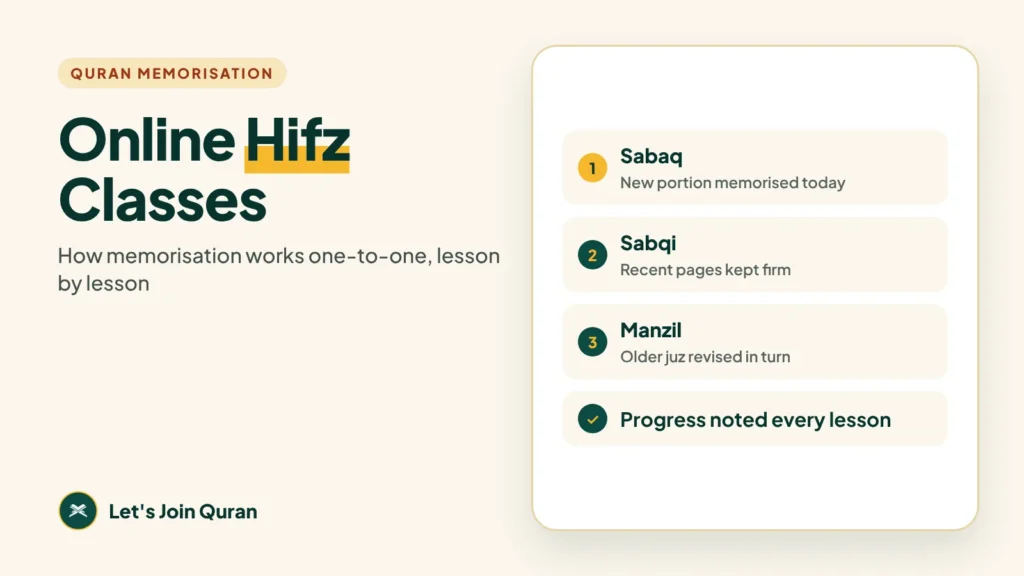
Most Hifz teachers, online and in person, build each lesson on three parts:
- Sabaq: the new portion memorised today, a few lines or a page depending on the student.
- Sabqi: recent portions, usually the last few days or the current juz, recited to keep them firm.
- Manzil: older portions revised in rotation, so earlier memorisation is never lost.
A student who only adds new sabaq and skips revision forgets quickly. The balance of the three parts is what makes Hifz last.
What a typical online Hifz session looks like
- Start with sabaq. The student recites today’s new portion from memory, and the teacher corrects any slip.
- Then sabqi. Recent pages are recited to check they are still firm.
- Then manzil. A set amount of older memorisation is revised.
- Set the next portion. The teacher reads the next lines with the student so the pronunciation is right before it is memorised alone.
Our Hifz Support plan uses 1-hour classes, because memorisation and revision together need more time than a reading lesson.
How progress is tracked
Every lesson the teacher notes how much was memorised, how the revision went and where mistakes appeared. Parents get regular updates, so you can see the pace and help with practice at home. Over months, this record shows clearly which juz are firm and which need more revision.
Is my child ready for Hifz?
A child is usually ready when they can read the Quran fluently from the page with correct Tajweed basics. If reading is still slow, memorising becomes frustrating and mistakes get memorised too. In that case, start with Noorani Qaida or Quran Reading, and move to Hifz once the reading is strong.
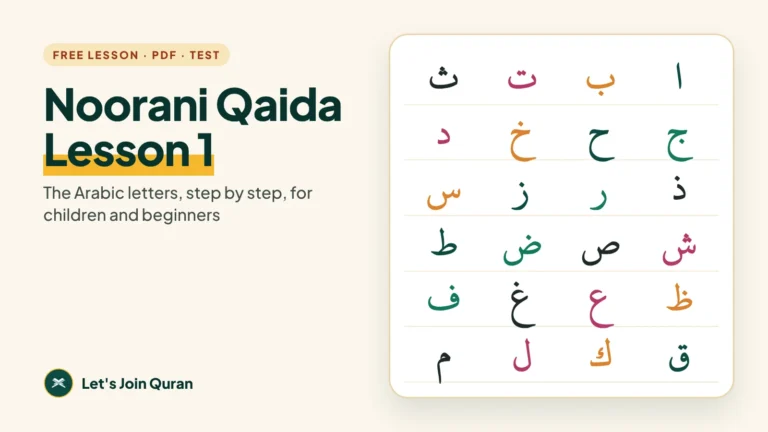
A quick way to check is our free online Noorani Qaida: if your child reads the last lessons smoothly, the foundation is in place.
How to support Hifz at home
- Fix a daily time for revision, ideally after Fajr or before bed, when the mind is fresh.
- Listen to the new portion recited by a trusted Qari before memorising, so the sound is already familiar.
- Read the sabaq aloud several times from the page before trying it from memory.
- Recite to a parent once a day, even if you are not a Hafiz; you can follow along in the Mushaf.
- Never skip manzil. Old portions slip away quietly if they are not revised.
How long does online Hifz take?
It depends on how much is memorised each day and how much time revision takes. A student memorising half a page a day, five days a week, with steady revision, can finish in roughly four to five years. Some go faster, some slower. A steady, unbroken routine matters more than a fast start.
Online Hifz classes for adults
Adults can memorise too, at their own pace. Many begin with the last juz or with surahs they pray in salah. Short daily sessions, a fixed time and steady revision matter more than age. Our Quran for Adults course is a good starting point if your reading needs work first.
Why the online format works for many families
- One-to-one attention: the teacher hears every word, not a whole class at once.
- No travel: more time for revision, especially in winter evenings.
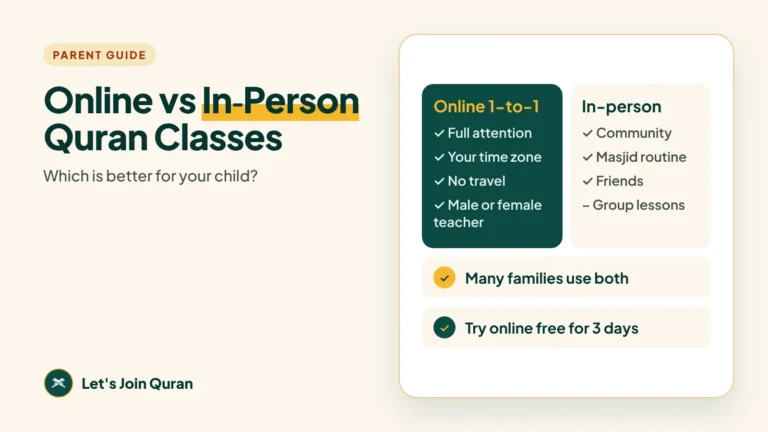
- Flexible timings for families in the United Kingdom, the United States, Canada and Australia.
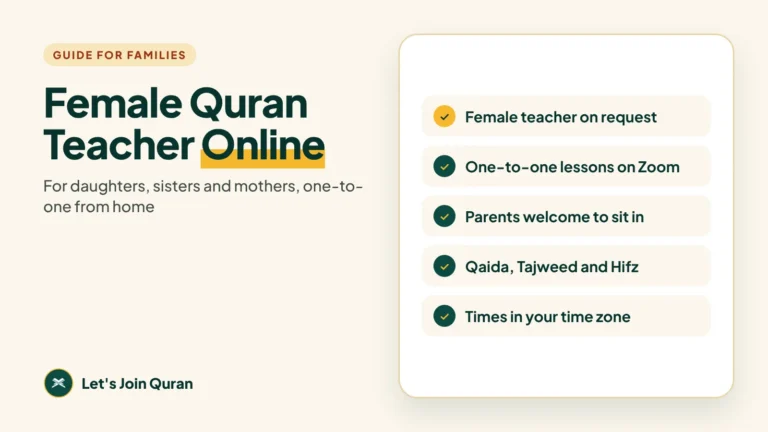
- Parents stay close: you can hear the lesson and see progress for yourself.
Keeping children safe online
Lessons follow a fixed timetable agreed with parents, and contact goes through the parent. Parents are welcome to sit nearby, especially in the first lessons. Ask any academy how teachers are chosen and checked before you begin.
Start online Hifz classes
Our Hifz course is one-to-one, with male and female teachers subject to availability. Book a 3 days free trial and the teacher will listen to your child’s reading and suggest whether to start Hifz now or strengthen reading first.
Can you really do Hifz online?
Yes. Hifz depends on a teacher listening to every word and correcting mistakes, and that works well one-to-one on a live video call. The method of sabaq, sabqi and manzil is the same as in a madrasa.
How long does it take to complete Hifz online?
It varies widely. Full-time students in a madrasa may finish in two to three years, while part-time students who memorise a few lines a day usually take several years. Consistency matters more than speed.
What age is best to start Hifz?
Many children start between 7 and 12, once they read the Quran fluently. The right time depends on reading ability, not age alone.
How long is each online Hifz class?
Our Hifz Support plan has 1-hour classes, which leaves time for new memorisation and revision in the same lesson.
Can adults join online Hifz classes?
Yes. Adults can memorise at their own pace, often starting with the last juz or the surahs they use in salah.

Let’s Join Quran is an online Quran academy dedicated to helping children, adults, and families learn the Quran with confidence through live 1-to-1 online classes. Our teachers focus on Noorani Qaida, Quran Reading, Tajweed, Hifz support, Islamic Studies, and beginner-friendly Quran learning for students worldwide.