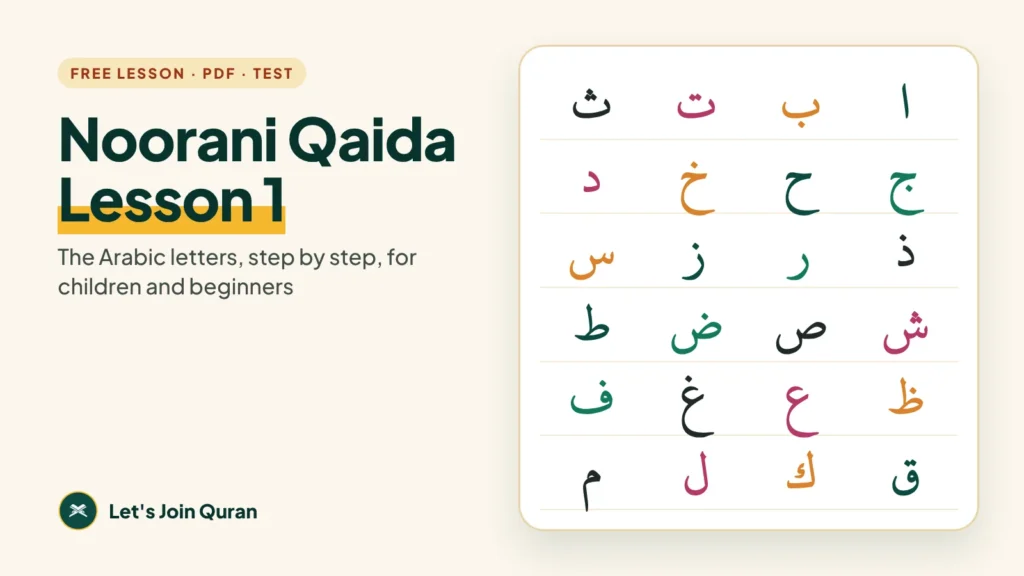
Noorani Qaida Lesson 1 teaches the single letters of the Arabic alphabet, called Huroof Mufradat. Your child learns each letter’s name, its shape, its dots and its correct sound before any joining or vowels. You can open the whole lesson for free in our online Noorani Qaida, print it as a PDF, and check your child with a short test at the end.
This guide explains what Lesson 1 contains, how to say each letter, which letters children mix up most, and how to teach the lesson at home in short daily sessions.
What Noorani Qaida Lesson 1 covers
Lesson 1 is the foundation of the whole Qaida. Every later lesson, from joined letters to Tajweed rules, is built on these letters. The lesson has three goals:
- Recognise every letter on sight, in any order, not just from A to Z.
- Know the dots: how many, and whether they sit above or below the letter.
- Say each letter from its correct place in the mouth or throat (its makhraj).
Arabic is read from right to left, so the lesson starts at the top right with Alif. Our Qaida page shows the letters in different colours, which makes them easier for children to tell apart.
The letters of Lesson 1 and how to say them
English has no exact match for some Arabic sounds, so the notes below are a starting point. A teacher who listens to your child is the only way to be sure each sound is right.
| Letter | Name | How to say it |
|---|---|---|
| ا | Alif | Has no sound of its own here. It carries a vowel or lengthens one in later lessons. |
| ب | Ba | Like b in bat, with both lips. |
| ت | Ta | A soft t. The tip of the tongue touches the back of the upper front teeth. |
| ث | Saa | Like th in think. The tongue tip shows slightly between the teeth. |
| ج | Jeem | Like j in jam. |
| ح | Ha | A breathy h from the middle of the throat, stronger than English h, with no scratch. |
| خ | Kha | Like ch in the Scottish word loch. A heavy letter. |
| د | Daal | A soft d, from the same place as ت. |
| ذ | Zaal | Like th in this. |
| ر | Raa | A tapped r, made with the tip of the tongue. |
| ز | Zaa | Like z in zoo. |
| س | Seen | Like s in sun. |
| ش | Sheen | Like sh in ship. |
| ص | Suaad | A heavy s. The back of the tongue rises, so the sound is fuller. |
| ض | Duaad | A heavy letter made with the side of the tongue against the upper back teeth. Practise it slowly with a teacher. |
| ط | Tuaa | A heavy t, from the same place as ت but with a full mouth. |
| ظ | Zuaa | A heavy version of ذ, with the tongue tip at the edge of the upper front teeth. |
| ع | Ain | A voiced sound from the middle of the throat. There is nothing like it in English. |
| غ | Ghain | A soft gargling sound, close to the French r. A heavy letter. |
| ف | Fa | Like f in fish. |
| ق | Qaaf | A deep k from the very back of the tongue. A heavy letter. |
| ك | Kaaf | Like k in kite, a little further forward than ق. |
| ل | Laam | Like l in lamp. |
| م | Meem | Like m in moon. |
| ن | Noon | Like n in nest. |
| و | Waw | Like w in water, with rounded lips. |
| ه | Ha | A light h from the deepest part of the throat, like h in hat. |
| ء | Hamza | A short catch in the throat, like the break in uh-oh. |
| ي | Ya | Like y in yes. |
Many Qaidas printed in Pakistan and India, including ours, end the page with ے (Bari Ya). It is the long final shape of Ya that children will also see in Urdu. It is not an extra letter of the Arabic alphabet.
Letters that look alike: learn them by their dots
Many Arabic letters share the same body and differ only in their dots. Teaching them in groups is much faster than learning 29 separate shapes.
- ب ت ث: one dot below, two dots above, three dots above.
- ج ح خ: one dot inside, no dot, one dot above.
- د ذ and ر ز: no dot, then one dot above.
- س ش: no dots, then three dots above.
- ص ض and ط ظ: no dot, then one dot above.
- ع غ: no dot, then one dot above.
- ف ق: one dot above, then two dots above.
A quick game helps here: cover a letter’s dots with your finger and ask, “If I put two dots on top of ب, which letter is it now?”
Letters children often mix up by sound
Some letters look different but sound close. These pairs need extra listening:
- ت and ط: light t and heavy t.
- س and ص: light s and heavy s.
- ذ, ز and ظ: three letters that English speakers often all say as z.
- ث and س: th and s.
- ح and ه: the middle-of-throat h and the light h.
- ء and ع: a catch in the throat and the voiced Ain.
- ك and ق: front k and back k.
Seven letters are always read heavy, with a full mouth: خ ص ض غ ط ق ظ. If your child learns these seven early, most sound mistakes later in the Qaida become easier to fix.
How to teach Lesson 1 at home
- Keep sessions short. Ten to fifteen minutes every day works better than one long session a week.
- Start from the right. Point to each letter as your child reads, so the eye learns to move right to left.
- Say the name, then the sound. Your child says “Ba”, and you listen for a clean b.
- Mix the order. Read from the end of the line, from top to bottom and from bottom to top, so your child knows each letter and has not just memorised the row.
- Ask about the dots. “How many dots? Above or below?” This prevents most reading mistakes later.
- Do not rush to Lesson 2. Move on only when your child can read every letter correctly in any order. A weak first lesson shows up in every lesson after it.
Common mistakes in Lesson 1
- Saying ع like a plain vowel, or leaving it out.
- Reading the heavy letters ص ط ظ ض as light ones.
- Saying ق as an English k.
- Mixing up ح and ه, or خ and ح.
- Reading the letters only in order from memory, without really recognising them.
How long does Noorani Qaida Lesson 1 take?
Most young children who practise for ten to fifteen minutes a day can read all the letters correctly within one to three weeks. Some take longer, and that is fine. Accuracy matters far more than speed at this stage. Adults usually move faster, but they need the same care with the throat letters and the heavy letters.
Practise Lesson 1 online, download the PDF and take the test
Everything you need for this lesson is free on our website:
- Open Lesson 1 in the online Noorani Qaida, one page at a time, on a phone, tablet or computer.
- Download the Lesson 1 page as a PDF to print, or download the full Noorani Qaida PDF.
- Take the Lesson 1 test. Letters appear in random order, and you can send the result on WhatsApp.
New to the Qaida? Start with our guide What Is Noorani Qaida? to see how all the lessons fit together.
Learning Lesson 1 with a teacher
A book or a screen can show the letters, but only a teacher can hear whether your child says ع, ق or ض correctly and fix it before the habit sets in. In our one-to-one Noorani Qaida classes, a teacher goes through each letter with your child on a live video call, at a time that suits your family. You can book a 3 days free trial to see how it works, with no card needed.
What is taught in Noorani Qaida Lesson 1?
Lesson 1 teaches the single letters of the Arabic alphabet (Huroof Mufradat): the name, shape, dots and correct sound of each letter, before any joining or vowels.
How many letters are in Noorani Qaida Lesson 1?
The Arabic alphabet has 29 letters, counting Hamza. Qaidas printed in Pakistan and India often also show Bari Ya (ے) at the end, which is the long final shape of Ya.
Is there a free Noorani Qaida Lesson 1 PDF?
Yes. You can download the Lesson 1 page or the full Noorani Qaida as a free PDF from our Noorani Qaida page, and read it online one page at a time.
How long does Lesson 1 take for a child?
With ten to fifteen minutes of daily practice, most young children can read every letter correctly within one to three weeks. Accuracy matters more than speed.
Can I teach Noorani Qaida Lesson 1 at home?
Yes. Parents can teach the letter shapes and names at home with short daily sessions. A teacher is still helpful for the throat letters and the heavy letters, which are hard to judge by ear.
When should my child move on to Lesson 2?
Move on only when your child can read every letter correctly in any order, including the dots and the heavy letters. Lesson 2 joins letters together, so gaps from Lesson 1 make it much harder.

Let’s Join Quran is an online Quran academy dedicated to helping children, adults, and families learn the Quran with confidence through live 1-to-1 online classes. Our teachers focus on Noorani Qaida, Quran Reading, Tajweed, Hifz support, Islamic Studies, and beginner-friendly Quran learning for students worldwide.